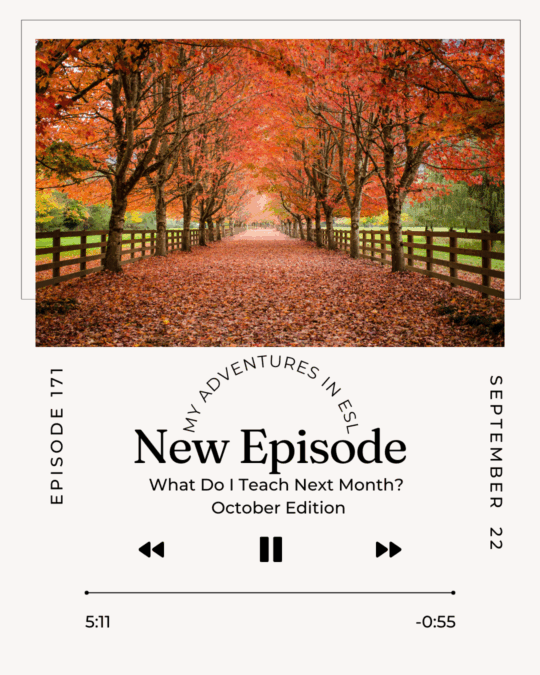
Ep. 171 What do I teach next month? October Edition
Welcome to the My Adventures in ESL podcast, the show dedicated to helping ESL teachers like you feel confident, supported, and inspired in your classroom. I’m so excited you’re here!
Each week, I share practical tips, strategies, and resources that you can take straight into your classroom. Whether it’s organizing your teaching space, planning lessons, or finding fresh ideas for your students, my goal is to make your teaching journey just a little bit easier and a whole lot more joyful.
Before we dive into today’s episode, I want to let you know about my Teacher Pay Teachers store, My Adventures in ESL. It’s filled with ready-to-use lesson plans, organizational tools, and engaging resources designed specifically for ESL teachers. So if you’re looking to save time and bring more clarity and confidence to your teaching, make sure to check it out—you’ll find the link in the show notes.
Now, let’s jump into today’s episode!
Teachers, I just want to take a moment to remind you how much of a difference you’re making right now. October can feel like a turning point in the school year—you’ve gotten past the whirlwind of the first few weeks, and now you’re really starting to know your students, their strengths, and the areas where they need you most.
It’s also the time when routines are settling in, and you may feel the weight of everything you’re balancing—lesson planning, compliance, meetings, and supporting your students emotionally and academically. I want you to hear this clearly: you are doing an incredible job. Every smile, every small win, and every strategy you try is helping your students grow, even if you don’t always see it right away.
So as you head into this new month, give yourself permission to celebrate the progress you’ve already made. October is full of fresh opportunities to engage your students, and you have all the creativity and heart you need to make this month meaningful for them.
You’ve got this, and I’m cheering you on every step of the way.
By the end of this episode, you’ll have three fun and engaging lesson ideas you can use right away in your ESL classroom this October. These activities are simple, adaptable for different language levels, and designed to save you time while keeping your students excited to learn.
Now, let’s be honest—October can be a tricky month for lesson planning. When I first started teaching, I noticed something year after year: those fun and fresh back-to-school lessons I leaned on in August and September just didn’t carry me into October. By the time this month rolled around, I found myself staring at my lesson plans thinking, “Okay… now what?”
And I know I’m not alone in this. Many ESL teachers hit this same wall—you’ve built routines, your students are settling in, but suddenly the excitement of the “new year” has worn off, and it can feel like you’re scrambling for engaging ideas to keep momentum going.
That’s exactly why I wanted to create this episode. Today, I’m going to share three interactive and engaging lesson ideas you can use right away this October to breathe new life into your classroom, spark your students’ curiosity, and give you back a little peace of mind.
✨ And here’s the best part—these aren’t complicated or time-consuming. The first idea is a perfect way to kick off the month with energy and get your students talking from the moment they walk in the door.
October is such a pivotal month in the school year. Your students are settling into routines, expectations are clearer, and in many ways, the real work of learning is just beginning. But with that comes a challenge—it can feel like the energy is dipping. The “new year” excitement fades, and suddenly, it’s up to us as teachers to find ways to reignite that spark and keep our students engaged. That can feel heavy, especially when your to-do list is already overflowing.
This is also a crucial month for benchmark testing and you and your students might be feeling the pressure.
So let me ask you—have you ever looked at your lesson plans in October and thought, “I want something new, something engaging, but I just don’t know where to start?”
This moment is so important because what happens in October can set the tone for the rest of the semester. If students lose motivation now, it’s harder to rebuild later. But when we bring fresh, interactive lessons into the classroom this month, we’re not just filling time—we’re fueling curiosity, encouraging collaboration, and giving our students a reason to be excited about learning every day. And let’s be honest, when students are engaged, we feel less stressed, more energized, and more in control of our classrooms.
So, how do we do this without adding hours of planning or searching for ideas? That’s exactly what this episode is about. I want to walk you through three simple, seasonal, and interactive lesson ideas that you can plug right into your classroom this October. These strategies are designed to save you time, keep students engaged, and add some fun to your routines.
✨ Let’s dive into the first one—it’s all about building energy and sparking student talk from the moment class begins.
🎙️ Lesson Idea #1: A Virtual Field Trip to the Pumpkin Patch
One of my favorite ways to bring October into the classroom is through a virtual field trip to a pumpkin patch. Now, I know what you might be thinking—“Isn’t that a little too young for my students?” But here’s the thing: pumpkins aren’t just about Halloween or carving jack-o’-lanterns. They open the door to culture, science, and language—all in one activity.
Here’s how it works:
Instead of physically going on a field trip, you can use videos, photos, or even interactive online tours of pumpkin farms and patches. You guide your students through the experience, pausing to highlight important vocabulary, ask questions, and encourage discussion.
👉 To make it more academic and age-appropriate:
- Add a science lens: Talk about the pumpkin life cycle, plant growth, and farming practices. This allows you to tie in science vocabulary and real-world connections.
- Add a math element: Challenge students to estimate weights, sizes, or even compare the growth stages of pumpkins.
- Add a cultural connection: Discuss how pumpkins are used differently across cultures—maybe even explore foods made with pumpkins from around the world.
👉 Language practice ideas:
- Have students complete a “Field Trip Journal” where they write or draw what they observed.
- Use sentence frames like: “I noticed…” / “I wonder…” / “The most interesting thing was…”
- Encourage partner or group discussions where students share their favorite facts.
This activity not only builds academic vocabulary, but it also helps students connect October themes to real-world knowledge. And the best part? You don’t need buses, permission slips, or complicated prep—it’s all digital and ready to go.
✨ Transition:
So, that’s our first October lesson idea: a virtual pumpkin patch field trip that blends culture, science, and language. Next, let’s look at another idea that keeps the season’s theme alive but adds even more interaction for your students.
🎙️ Lesson Idea #2: Celebrating International School Library Month
October isn’t just about pumpkins and fall leaves—it’s also International School Library Month. And this is a golden opportunity to engage your ESL students with books, storytelling, and language-rich activities that go far beyond simply reading a text.Here’s how it works:
Instead of just assigning a book, turn your classroom into a mini library exploration. You can introduce students to your school library (physically or virtually) and guide them in discovering new genres, authors, and stories from around the world.
👉 To make it engaging and age-appropriate:
- Genre Exploration: Give each student or group a genre—like mystery, fantasy, biography, or poetry—and have them learn key vocabulary and share a short summary of what makes that genre unique.
- Book Culture: Highlight how libraries look different across countries. Show photos or short videos of libraries around the world, then invite students to compare them with their own experiences.
- Research Skills: Teach students how to find a book using the online catalog or by call numbers—practical skills they’ll use throughout school.
👉 Language practice ideas:
- Book Talks: Students can prepare short, structured “book commercials” to recommend a favorite book.
- Reading Passages: Select short excerpts (age-appropriate and leveled) and let students practice fluency by reading aloud in pairs.
- Writing Extension: Ask students to create a “Library Passport” where they record the books or genres they’ve explored and write a reflection sentence after each visit
👉 Cross-curricular connection:
- Tie in history by exploring how libraries have preserved knowledge through time.
- Bring in art by having students design their own library bookmarks with inspiring quotes.
This activity not only builds reading and speaking confidence but also emphasizes that libraries are safe, welcoming spaces for lifelong learning. By connecting students with the library early on, you’re giving them tools they’ll use far beyond your classroom.
So that’s our second October lesson idea: celebrating International School Library Month with activities that blend culture, language, and exploration. Now, let’s move into our final idea for the month—one that taps into creativity and gets your students working together in an engaging way
October just wouldn’t feel complete without a little storytelling fun. But instead of making it too “Halloween-y” and also making it accessible to ALL ages, this activity allows your students to explore spooky stories and folktales from different cultures—all while practicing essential language skills.
Here’s how it works:
Introduce your students to the idea that every culture has its own legends, ghost stories, and folktales. You might share a short, age-appropriate version of a folktale from your students’ home countries—or ask them to share stories they’ve heard growing up.
👉 To make it engaging and age-appropriate:
- Story Circles: Break students into small groups and have each group retell a short folktale in their own words. This builds speaking fluency and listening comprehension.
- Story Maps: Have students use graphic organizers to map out the characters, setting, problem, and resolution of a folktale or spooky story.
- Rewrite the Ending: Students can take a traditional story and write their own alternative ending, encouraging creativity and writing practice.
👉 Language practice ideas:
- Vocabulary Hunt: Pull out key descriptive words (creepy, mysterious, ancient, brave) and have students practice using them in new sentences.
- Reader’s Theater: Turn a folktale into a short script and let students perform—it’s fun, collaborative, and gets them speaking with expression.
- Writing Extension: Have students write their own “mini spooky tale” of 3–5 sentences with illustrations, depending on their language level.
👉 Cross-curricular connection:
- Tie in social studies by highlighting where the story comes from on a world map.
- Connect with art by letting students create simple illustrations of their favorite scene or character.
✨ Why it works:
This lesson idea helps students see that storytelling is universal—it connects people across cultures and generations. And by exploring spooky or mysterious tales, you’re giving them a chance to have fun while practicing speaking, listening, reading, and writing in meaningful ways.
These are three lesson ideas that will help you keep your October lessons interactive, engaging, and meaningful for your ESL students.
And that’s a wrap for today’s episode! We’ve explored three engaging, interactive lesson ideas for October:
- A virtual field trip to a pumpkin patch, blending science, culture, and language.
- Celebrating International School Library Month, with reading, research, and discovery activities.
- Spooky stories and folktales from around the world, encouraging creativity, storytelling, and cross-cultural connections.
Each of these lessons is designed to be flexible, adaptable for different language levels, and—most importantly—to make learning fun and meaningful for your students.
If you enjoyed these ideas and want to save time planning, don’t forget to check out my Teacher Pay Teachers store, My Adventures in ESL. You’ll find ready-to-use templates, lesson plans, and activity guides that align perfectly with what we talked about today. The link is in the show notes.
Remember: your creativity, heart, and intentional planning make a huge difference for your students. Take one or two of these ideas and try them in October—you’ll be amazed at the engagement and excitement they bring into your classroom.
Thanks so much for listening, and I can’t wait to share more strategies, tips, and ideas with you in the next episode. Until then, happy teaching and enjoy your October adventures in ESL!