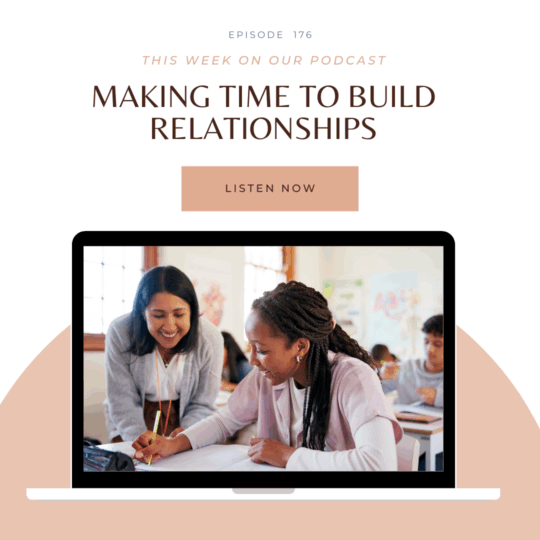
EP 176 But My Class Is Too Big / I Don’t Have Time — Can I Still Build Real Relationships?
Hey teacher friend — before we go any further, I want to acknowledge where you are right now.
You’re teaching.
You’re planning.
You’re grading.
You’re attending meetings.
You’re managing behavior, supporting language development, and keeping up with the endless flow of responsibilities that come with being an ESL teacher.
And through all of that, you’re trying to build genuine relationships with your students — the kind that make them feel safe, valued, and confident in your classroom.
But I know this isn’t easy.
When class sizes are large and your schedule is packed, it’s natural to wonder:
“How am I supposed to connect with every student when I barely have a moment to breathe?”
If you’re feeling that, take a deep breath with me.
Because here’s the truth you might need today:
You are enough.
The fact that you care about building relationships already shows the kind of teacher you are — thoughtful, intentional, and committed.
This blog post isn’t about adding more to your workload.
It’s about helping you find realistic, meaningful, and sustainable ways to build authentic connections with your students — no matter how many of them you teach or how limited your time feels.
Let’s walk through how you can create connection with ease, purpose, and joy.
⭐ My Turning Point as an ESL Teacher
There was a season in my teaching career when relationship-building felt impossible.
My ESL classes were large.
My students spanned every language level.
And like you, I was juggling lesson plans, grading, compliance work, and endless paperwork.
Some days, I felt like students were slipping through the cracks.
I smiled. I greeted them. But deep down, I knew I wasn’t giving every student the attention they deserved.
Then one afternoon, something shifted.
A small group of students — the very ones I had struggled to connect with — told me they were happy to be in my class.
It stopped me in my tracks.
I realized that even though I didn’t have time for big gestures, the small things — the check-ins, the smiles, the two-minute chats — they mattered.
From that moment on, I stopped focusing on what I couldn’t do and started focusing on what I could do.
That approach changed everything.
🌟 Strategy #1: Start With Simple, Consistent Check-Ins
When your class size is big, long conversations with every student aren’t realistic.
But small, regular interactions?
They’re powerful — and they’re doable.
Here’s how to build connection through simple routines:
✔️ Greet students by name
A warm “Good morning, Fatima!” or “Glad you’re here today, Daniel!” builds instant belonging.
✔️ Use transitions to your advantage
Two-minute chats during lining up or gathering materials can feel surprisingly personal:
- “Did your game go well yesterday?”
- “How’s your little sister doing?”
- “What are you excited for this weekend?”
✔️ Add weekly reflection routines
Use exit tickets or digital forms that ask:
- How are you feeling today?
- What challenged you this week?
- What’s something you want me to know?
These quick check-ins build trust without adding work.
Small moments add up.
Consistency is what makes them powerful.
💬 Strategy #2: Build Relationships Through a Shared Classroom Culture
If you can’t connect deeply with every student every day, create a classroom culture that connects everyone.
This means building predictable routines and shared experiences that make students feel part of something bigger.
Try the following:
✔️ Start class with predictable warm-ups
A daily question.
A greeting routine.
A short affirmation.
Predictability creates safety — and safety creates connection.
✔️ Celebrate student voices
Showcase multilingualism.
Highlight student work.
Invite students to share something about themselves.
When students see their identity reflected in your classroom, connection naturally follows.
✔️ Use “we” language
“We’re learning this together.”
“We’re growing as a class.”
This transforms your classroom into a community, not a collection of individuals.
💡 Strategy #3: Use Systems to Stay Connected Without Burnout
You shouldn’t have to rely on memory or extra time to build relationships.
Systems make connection predictable — and sustainable.
Here are a few simple systems you can use:
✔️ Weekly Connection Rotation
Choose 5 students each day to connect with for 1–2 minutes.
By the end of the week, you’ve touched base with almost everyone.
It’s small, but incredibly effective.
✔️ Peer Partnership Programs
Pair students for academic and social support.
When students support each other, connection multiplies — even when your time is limited.
✔️ Digital Reflection Tools
Use Google Forms, Flip, or Jamboard to let students:
- check in
- ask questions
- share feelings
These tools keep communication open without adding more to your workload.
Systems turn relationship-building into a rhythm, not a task.
🎙️ Your Work Matters — Every Small Moment Counts
Before you go, I want you to hear this clearly:
Your impact is not measured by how much time you have.
It’s measured by how much intention you bring.
Even the smallest gestures — a smile, a greeting, a note of encouragement — can mean the world to a student learning a new language in a new country.
So here’s your challenge for the week:
👉 Choose ONE strategy from this post and put it into practice.
It could be:
- greeting students by name
- adding a weekly reflection routine
- starting a simple peer-partner system
- rotating daily check-ins
One small step can change the culture of your classroom.
And when you try it, I’d love to hear how it goes!
Share your experience with me on Instagram @myadventuresinesl — I love hearing your wins and aha moments.
You’re doing incredible work.
Even on the hard days.
Even when you feel stretched thin.
Your students feel the care you bring — and it matters more than you know. 💛