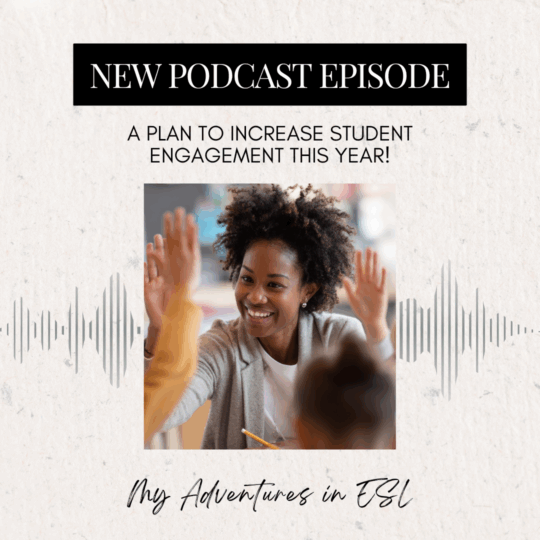
Ep. 172 My Plan to increase student engagement this year!
Welcome to the My Adventures in ESL podcast, the show dedicated to helping ESL teachers like you feel confident, supported, and inspired in your classroom. I’m so excited you’re here!
Each week, I share practical tips, strategies, and resources that you can take straight into your classroom. Whether it’s organizing your teaching space, planning lessons, or finding fresh ideas for your students, my goal is to make your teaching journey just a little bit easier and a whole lot more joyful.
Before we dive into today’s episode, I want to let you know about my Teacher Pay Teachers store, My Adventures in ESL. It’s filled with ready-to-use lesson plans, organizational tools, and engaging resources designed specifically for ESL teachers. So if you’re looking to save time and bring more clarity and confidence to your teaching, make sure to check it out—you’ll find the link in the show notes.
Now, let’s jump into today’s episode!
Welcome back, teachers! I want to take a moment before we dive in to remind you that you are doing an incredible job. This is a safe space for you to pause, breathe, and reflect. I know that teaching—especially as an ESL teacher—comes with its unique challenges. You’re balancing lesson planning, student needs, compliance, and sometimes it feels like there just aren’t enough hours in the day.
But here’s the truth: your hard work is making a difference. Every smile, every student who feels seen and included, every “aha!” moment in your classroom—it’s because of the time, energy, and heart you put into this work.
So as we step into today’s episode, I want you to feel encouraged. You don’t have to have it all figured out right now. You’re not alone. This podcast is your safe space to find ideas, inspiration, and support to make your teaching life a little lighter and a lot more joyful.
By the end of this episode, my goal is for you to leave with three simple and effective strategies that you can use right away to boost engagement in your ESL classroom. These are easy to implement, practical for your students’ needs, and designed to help you start the year strong with confidence and energy.
When I first started teaching, I was always so eager to jump straight into the content. I’d plan out lessons, gather materials, and walk into class ready to dive right in. But what I quickly noticed was that my students weren’t always as eager as I was. Some would sit quietly, others would disengage, and a few would even get restless. I realized that while I was focused on delivering the content, I wasn’t always intentional about how I was engaging my students. Without that engagement piece, it didn’t matter how solid my lesson plan was — students weren’t connecting, and the learning just wasn’t sticking. That was a hard but important lesson for me: teaching isn’t just about what we teach, it’s about how we bring students into the learning process.
I know I’m not alone in that experience. As teachers, we pour so much time and energy into creating lessons, but when we look out at our students and see blank stares, disengagement, or just going through the motions—it can be discouraging. We want our classrooms to feel alive, full of curiosity and excitement. We want students leaning in, not checking out. And when that doesn’t happen, it can leave us questioning ourselves, wondering if all the effort is even worth it. The truth is, every teacher has been there, and it doesn’t mean you’re failing—it means you’re human. What matters is how we respond and what we do next to reignite that spark in our classrooms.
So let me ask you this—what would your classroom feel like if your students were consistently engaged? Imagine walking in each day and knowing your students are ready to participate, eager to learn, and invested in the lesson. How would that change not only your teaching but also their learning experience?
Here’s why this matters so much. Engagement isn’t just about keeping students busy—it’s about creating meaningful connections to learning. When students are actively involved, they retain more, they’re less likely to shut down or get distracted, and they feel like they truly belong in your classroom. For us as ESL teachers, engagement is even more critical because it builds language confidence, encourages risk-taking, and fosters a safe environment where students aren’t afraid to make mistakes. In short, when engagement is high, learning accelerates, and teaching becomes less about managing behavior and more about inspiring growth.
So how do we make this shift from students just sitting and listening to students fully engaged in the lesson? The good news is that engagement doesn’t have to be complicated or time-consuming. It’s about making intentional choices—building in moments where students talk more than we do, connecting activities to their real-world experiences, and adding structure so they know what’s expected. Think of it like sprinkling small engagement boosters throughout your lesson. When we approach engagement this way, it feels doable, not overwhelming. And today, I’m going to share a few simple strategies you can start using right away to see the difference.
If you’re ready to take your classroom organization to the next level, I’ve got you covered. Over the years, I’ve developed practical tools and systems that make staying organized easy—and they’re all available in my Teacher Pay Teachers store.
From ready-to-use student supply organizers to lesson planning templates and compliance trackers, these resources are designed to save you time, reduce stress, and help your classroom run like a well-oiled machine. The best part? They’re simple, flexible, and easy to implement right away—so you can focus on what matters most: teaching your students.If you want to check them out, head over to my store at My Adventures in ESL, and start building the classroom of your dreams today.
The first strategy to increase engagement is using quick, structured student talk activities. Here’s the hook—students learn language best when they’re actually using it. But too often, ESL students sit quietly while we do most of the talking. That’s a missed opportunity. Instead, we can build in short, focused talk moments that give every student a voice.
For example, try a ‘Turn and Talk’ where students respond to a question with a partner for just 30 seconds. Or use sentence stems on the board like, ‘I agree with you because…’ or ‘One example is…’ so students feel confident jumping in. Another idea is to do a quick ‘Stand Up, Hand Up, Pair Up’ where students walk, meet a partner, and share their answer before switching. These small changes add bursts of interaction that keep students alert, accountable, and excited to contribute. Plus, they’re easy to fit into any lesson without reworking your whole plan.
Strategy #2 is all about incorporating student choice into your lessons. Students are naturally more engaged when they feel ownership over their learning. Giving them options doesn’t have to be complicated, but it can completely change the energy in your classroom.
For example, when assigning a reading or writing activity, offer a few different topics or formats. Students could choose to write a short story, create a comic strip, or make a visual summary. In speaking activities, let them decide whether to present to a small group, a partner, or even record a short video. Even small choices, like picking a discussion question from a list or selecting a role in a group project, give students a sense of control and make them more invested in the activity.
The beauty of this strategy is that it works for every language level. By scaffolding the options and providing sentence frames or graphic organizers, every student can participate meaningfully, and you’ll see engagement soar without adding extra prep time.
Strategy #3 is to incorporate movement and interactive games into your lessons. Here’s the hook—students retain more when learning involves their bodies, not just their brains. And in ESL classrooms, movement can be a powerful tool to reinforce language while keeping energy high.
For example, try a vocabulary scavenger hunt around the classroom. Students can search for cards with words, match them to definitions, or even act them out. Another option is a ‘Gallery Walk,’ where you post questions or prompts around the room and students rotate to respond at different stations. For grammar or sentence practice, you can play quick interactive games like ‘Find a Friend Who…’ or simple role-play scenarios that get students up and talking.
These activities not only make learning more fun, but they also give students a chance to use language actively, collaborate with peers, and stay engaged from start to finish. And the best part? Most of these ideas are low-prep and adaptable for all ages and language levels.
So there you have it—three practical strategies to boost student engagement this year: quick, structured student talk activities, giving students meaningful choices, and incorporating movement and interactive games. Each of these strategies is simple, adaptable, and designed to help your students stay actively involved in learning while making your classroom a more dynamic and enjoyable place.If you take even one of these strategies and implement it this week, you’ll start to see how small, intentional changes can make a big difference in your students’ participation and enthusiasm. And if you want even more ready-to-use resources, lesson ideas, and tools to help you engage your students from day one, be sure to check out my Teacher Pay Teachers store, My Adventures in ESL. You’ll find practical materials that align perfectly with the strategies we talked about today.




3 Comments
basketball stars unblocked
This is the ultimate ESL teacher comfort food! Seriously, reading this felt like finding that missing piece of a puzzle I didnt even know was missing. The Turn and Talk idea alone is a lifesaver, and the way it acknowledges weve all been there with blank stares is both validating and hilarious. Choosing between a story, comic, or video for a reading assignment sounds like a genius way to make our students think we care (even if we just want them to finish the task). And bonus points for mentioning movement – because nothing says Im engaged like accidentally elbowing someone during a game! Keep these strategies coming; my classrooms energy level is about to get a major boost, and my coffee cup will thank you too!basketball stars unblocked
football bros unblocked
LOL, finally! Someone else gets it—teaching without engagement is like trying to pour water through a straw. Who has time for blank stares? These strategies are the magic beans! Quick talk? Yes, please! Choice? Now were cooking with fire (and student motivation)! And movement? Because sitting still is basically ESL student punctuation! Thanks for the no-nonsense, actually useful tips that dont require a PhD or a small fortune. My classroom can start feeling alive, maybe tomorrow… fingers crossed!football bros unblocked
runway act two
This is gold! Seriously, as someone whos definitely been the teacher with the blank stares, this hits different. The idea of sprinkling in quick, structured student talk activities like Turn and Talk is genius – who knew 30 seconds of partner chat could work wonders? And giving students *any* choice, like picking between a story and a comic, sounds like a game-changer for classroom energy. Who wouldnt want to feel invested? Plus, incorporating movement so theyre using their bodies while learning? Perfect for those kinesthetic learners (and maybe the teacher who needs to wiggle!). Thanks for the laugh and the light-hearted yet practical strategies – definitely needed a pick-me-up!runway act two