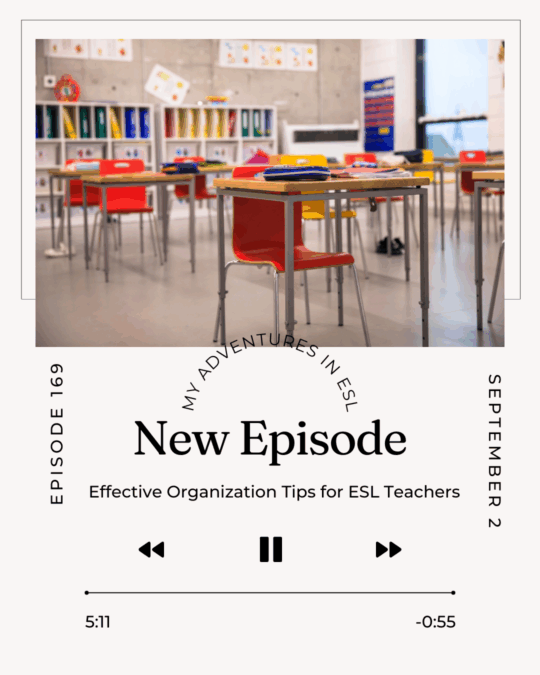
Ep. 169 Effective Organization Tips
Hey there, amazing ESL teachers! 🎉 It’s a brand-new school year, and I know you are already pouring your heart into creating a classroom where your students feel safe, supported, and excited to learn. These first weeks can feel like a whirlwind—but the routines you’re building and the connections you’re making are setting the tone for the entire year.
You’re not just teaching English—you’re opening doors, building confidence, and creating a space where every student knows they belong. So keep showing up, keep smiling, and remember—you’re doing incredible work that matters every single day.
And because I know you’re working hard to keep everything running smoothly, today we’re diving into practical, effective organization tips that will help you save time, reduce stress, and create the calm, focused classroom your students need to thrive. Let’s jump in!
By the end of today’s episode, my goal is for you to walk away with a few simple, powerful organization strategies that you can put into action right away—strategies that will help you feel more in control, more focused, and better able to give your energy to what matters most: your students.
When I first started teaching ESL students, my classroom was… well, let’s just say it was a bit of a disaster zone. Papers piled high on my desk, folders scattered in every corner, and student supplies tucked away in random spots—if they had a spot at all. Every time I needed something, it felt like I was going on a scavenger hunt. I remember one afternoon frantically digging through stacks of paper while my students sat waiting, and thinking, This cannot be the way my classroom runs all year.
That’s when it clicked—organization wasn’t just about making things look nice. It was about creating a smoother, calmer, more efficient learning environment for me and for my students. Little by little, I started making changes. I set up a dedicated spot for all those compliance documents we have to keep track of. I designed storage systems so students knew exactly where to find and return their supplies. I carved out a personal workspace where I could plan, grade, and think without being buried under clutter.
Over time, these systems became second nature—not just to me, but to my students. And here’s the best part: the organization strategies I put in place years ago are still working for me today. They’ve stood the test of time because they’re simple, practical, and they make the classroom run like a well-oiled machine.
Now imagine walking into your classroom knowing exactly where everything is. No frantic searching. No lost supplies. Just calm, focused energy that lets you be fully present with your students.
So here’s what I want you to think about—what would it feel like to walk into your classroom each day knowing exactly where everything is, with systems that keep things running smoothly even when life gets hectic?
Having a solid organizational system isn’t just about neat folders or labeled bins—it’s about making your classroom work for you.
When everything has a place, classroom management gets easier. Students know where to find supplies, where to turn in work, and what routines to follow. That means fewer disruptions and more time for actual learning.It also saves you time. No more frantic searching for materials or lost papers—you can grab what you need and focus on teaching.
And perhaps the best part? It reduces overwhelm. Teaching ESL is already challenging, and a chaotic classroom only makes it harder. With clear systems in place, your days feel calmer, your stress drops, and you can put your energy where it matters most: supporting your students.
Organization isn’t just a nice-to-have—it’s the key to a smoother, calmer, and more effective classroom.
Let’s talk about how you can create organizational systems that work—not just look pretty. My number one tip? Start with a purge.
Take a good, hard look at your classroom and ask yourself: Do I really need all of this? Old papers, outdated worksheets, broken supplies—if it hasn’t been used in a while, let it go. Clearing out the clutter gives you space to build systems that actually function.
Next, think about dedicated zones. Have a spot for student supplies, a place for completed work, and a space for your planning materials. When everything has a home, students know where to go, and you don’t waste precious minutes searching for things.
Finally, make it simple and sustainable. Don’t create a system you’ll spend more time maintaining than using. Labels, color-coding, and clear containers can make organization intuitive for both you and your students.
Start with the purge, assign clear zones, and keep it simple—and suddenly, your classroom feels calmer, smoother, and ready for learning.
If you’re ready to take your classroom organization to the next level, I’ve got you covered. Over the years, I’ve developed practical tools and systems that make staying organized easy—and they’re all available in my Teacher Pay Teachers store.
From ready-to-use student supply organizers to lesson planning templates and compliance trackers, these resources are designed to save you time, reduce stress, and help your classroom run like a well-oiled machine. The best part? They’re simple, flexible, and easy to implement right away—so you can focus on what matters most: teaching your students.
If you want to check them out, head over to my store at My Adventures in ESL, and start building the classroom of your dreams today.
Student Bins
Let’s dive into my first strategy: student bins—one of the simplest ways to keep your classroom organized and your students on track.
Each student gets their own bin, which becomes their personal “workstation on the go.” I typically include a supply box with pencils, markers, scissors, and glue, plus a notebook and a binder for their classwork and handouts. When students enter the room, they know exactly what to do: grab their bin, pull out the materials they need, and settle in to start their work—no scrambling, no distractions.
You can get creative with what goes in the bins based on your classroom needs. Some ideas include:
- Mini whiteboards and markers for quick practice
- Index cards for vocabulary or sentence prompts
- Sticky notes for brainstorming or reminders
- Highlighters or colored pencils for reading or grammar activities
I also keep designated supply areas around the room for items that students might need in addition to their bin—things like extra pencils, scissors, or reference materials. This way, students learn responsibility, know exactly where to go for what they need, and your classroom stays tidy.
Student bins create structure, save time, and give your students a clear routine—all while keeping your space organized and functional.
File Cabinet for Compliance
Another strategy that transformed the way I manage my classroom is compliance file folders. These folders are a game-changer for keeping all of your required student documentation in one easy-to-access place.
In my classroom, I have a dedicated file cabinet just for these folders. Inside, I keep everything from primary home language surveys to assessment data and language plans. To make things even more efficient, I color-code the folders: active ESL students might have one color, while transitional students have another. This way, I can instantly grab the right folder and get the information I need—no digging, no stress.
You can easily create your own compliance folders. Here are a few ideas:
- Color-code by student type: active, transitional, or exited ESL students
- Include clear tabs for different types of documentation: surveys, assessments, parent communication, goals
- Use sheet protectors to store important papers that you reference often
- Add a quick summary page at the front of the folder so you can see a snapshot of the student’s information at a glance
Having these folders makes it so much easier to stay organized, meet requirements, and have student information at your fingertips whenever you need it. Plus, color-coding adds a visual cue that makes your life just a little bit easier every single day.
And that wraps up today’s episode on effective organization tips for ESL teachers! I hope you’re leaving with ideas you can implement right away—whether it’s setting up student bins, creating compliance folders, or simply starting with a purge to clear the clutter in your classroom.
Remember, organization isn’t just about neat spaces—it’s about saving time, reducing stress, and creating a classroom where your students can thrive. Even small changes can make a big difference in how smoothly your day runs and how confident your students feel.
If you found today’s tips helpful, I’d love for you to check out my Teacher Pay Teachers store, where you’ll find ready-to-use tools and templates to make your classroom organization even easier. Head over to My Adventures in ESL and start implementing these strategies today.
And don’t forget—organization is a journey, not a one-time fix. Take it step by step, celebrate your progress, and watch how calmer, focused, and effective your classroom can become. Thanks for listening, and I’ll catch you in the next episode!